Maintenance
Recognise engine deterioration before a shutdown
Rising specific fuel oil consumption preceded a crank-bearing failure, showing the value of investigating early deviation alerts.
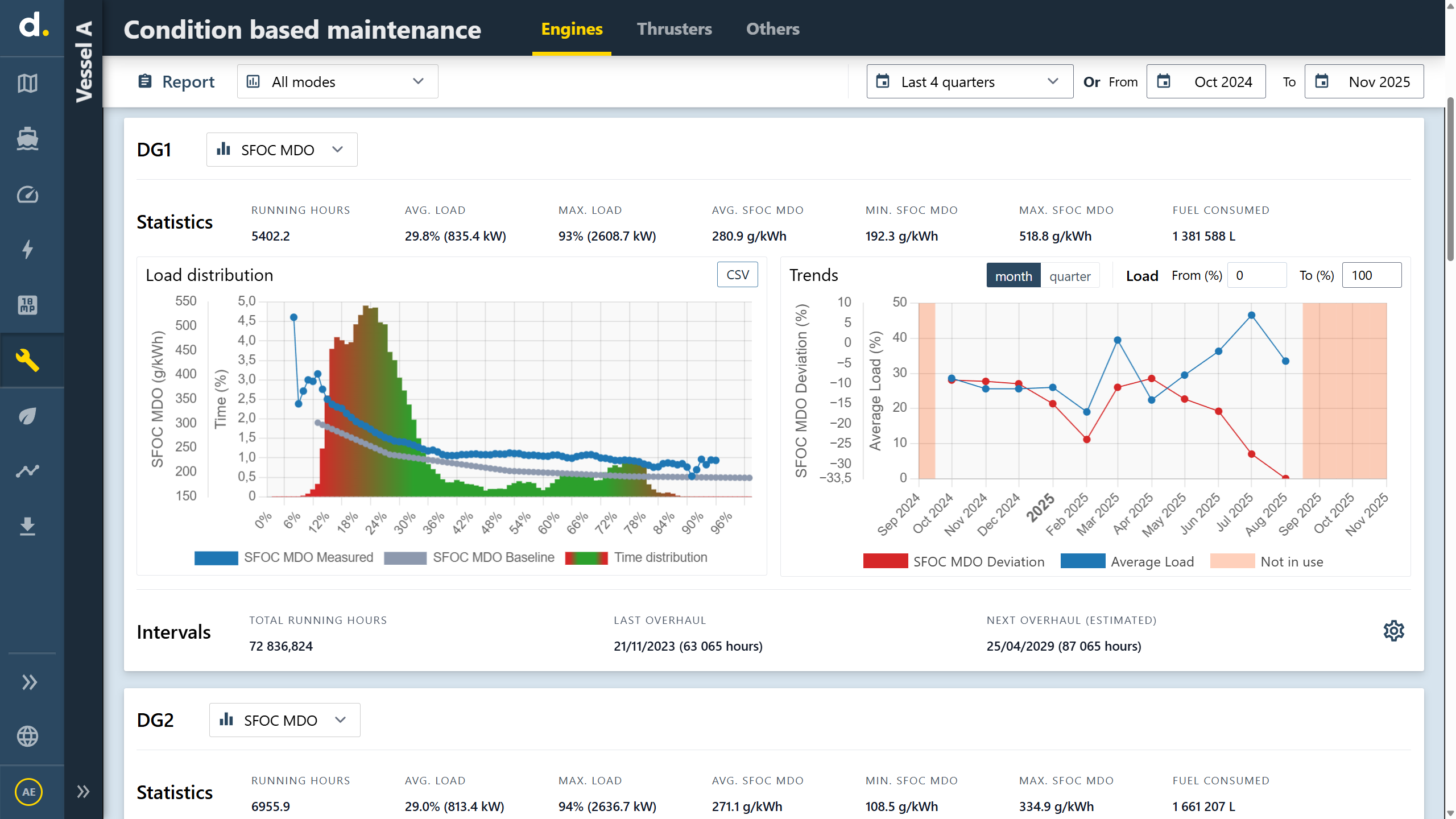
A progressive rise in specific fuel oil consumption (SFOC) indicated engine degradation months before a failure. This retrospective case shows how condition trends can give a technical team an earlier reason to investigate.
Track condition against the baseline
Dipai monitors critical condition parameters to identify emerging engine faults. SFOC deviation is tracked against monthly baselines, with automated alerts drawing attention to changes in engine performance.
In the presented case, the reported SFOC increase rose from 8.7% in April 2025 to 13.8% in May, 16.8% in June, 27.4% in July and 33.5% in August.
Connect the trend to the operational event
In September 2025, crank bearing number 5 failed. The engine was fully shut down until the crankshaft could be replaced.
The progressive change in fuel performance was therefore visible before the failure. Reviewing the history alongside load and operating context gives technical teams a clearer picture of the deterioration.
Use an alert as a prompt to investigate
The presentation identifies early deviation alerts as an opportunity to intervene before out-of-service downtime. In this retrospective case, the warning trend was visible for several months before the September failure.
The use case is the opportunity to bring investigation and maintenance decisions forward when condition trends move away from the baseline.
Retrospective case: April–August 2025 deterioration followed by an engine shutdown in September. The case illustrates an earlier opportunity to intervene.